Protecting New Jersey homes since 2007…

If you have noticed a slight inward curve in your basement walls or a series of horizontal cracks appearing near the midline of your foundation, you are not alone. For homeowners in New Jersey, soil conditions and seasonal weather patterns create a “perfect storm” for structural instability. Seeing your foundation bow can be a source of significant anxiety, but the solution no longer requires the invasive, costly traditional methods of the past.
At Healthy Way Waterproofing & Mold Remediation, we advocate for the “100% Solution.” When it comes to stabilizing a home, carbon fiber has emerged as the gold standard for foundation repair. It offers a permanent, non-obtrusive fix that addresses the root cause of the movement without turning your yard into a construction site.
The Science of the “Jersey Squeeze”: Clay Soil and Hydrostatic Pressure
To understand why walls bow, we have to look at what is happening outside your home. Much of New Jersey—from the suburbs of Morristown to the coastal plains near Middletown—sits on soil with high clay content. This is a primary driver of structural distress.

Why NJ Clay Expands and Pushes Against Your Foundation
Clay is an expansive material. During the heavy rains common in the New Jersey spring or during a rapid snowmelt, the clay soil surrounding your foundation absorbs vast amounts of water. As it saturates, it expands in volume, exerting a massive amount of weight against your basement walls. This force is known as hydrostatic pressure.
When the pressure from the outside exceeds the load-bearing capacity of the concrete or cinder block wall, the wall begins to deflect inward. In the winter, this is further exacerbated by the “freeze-thaw” cycle, where freezing groundwater expands with even greater force, pushing the foundation to its limits.
Signs Your Basement Walls are Reaching a Breaking Point
Early detection is the key to avoiding a total foundation collapse. While some shifts are subtle, your home will usually provide several warning signs that the “Jersey Squeeze” is taking its toll.
Horizontal Cracks vs. Stair-Step Cracks
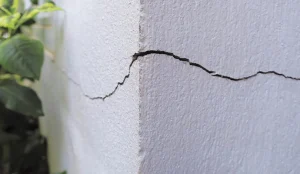
In a block foundation, you might see stair-step cracks following the mortar lines. This often indicates settling at the corners. However, the most concerning sign for a bowing wall is a long horizontal crack running across the middle of the wall. This is a clear indicator that the wall is buckling under lateral pressure. If you can see the top of the wall leaning inward or “shearing” at the bottom, the situation has moved from a maintenance issue to a structural emergency.
Carbon Fiber Straps: The Non-Invasive Foundation Revolution
Historically, the only way to fix a bowing wall was to install heavy steel I-beams or excavate the entire exterior of the home. Today, carbon fiber technology has revolutionized the industry.
How Carbon Fiber Provides 10x the Strength of Steel
Carbon fiber is a high-strength material used in aerospace and bridge construction. When used for foundation repair, it is woven into tough, flexible straps that are bonded directly to the foundation wall. Despite being thinner than a coin, these straps are virtually unbreakable and possess a tensile strength significantly higher than steel.
The “Healthy Way” Installation Process
Our process is designed to be as clean and efficient as possible. First, we grind the surface of the wall to ensure a pristine bond. We then apply a high-strength epoxy and press the carbon fiber strap into place, anchoring it to both the sill plate (top) and the floor (bottom). Once the epoxy cures, the strap becomes a part of the wall itself, preventing any further inward movement forever.
Why “DIY” Foundation Patches Fail in Northern NJ
Many homeowners attempt to patch cracks with hydraulic cement or store-bought sealants. While this might stop a minor water leak temporarily, it does absolutely nothing to address the structural tension. A patch cannot stop a 50-ton wall from moving. Without professional reinforcement like carbon fiber, the hydrostatic pressure will simply cause new cracks to form around the patch, leading to a much more expensive repair down the road.
Frequently Asked Questions
How much does foundation repair cost in NJ?
While every home is different, carbon fiber reinforcement is often 50% more cost-effective than traditional steel beams or total wall replacement because it requires significantly less labor and no heavy machinery.
Can I paint over carbon fiber straps?
Yes! This is one of the biggest benefits. Unlike bulky steel I-beams that take up floor space and look industrial, carbon fiber straps are nearly flush with the wall. They can be painted over or easily hidden behind a finished basement wall.
How long does the repair take?
Most carbon fiber installations are completed in a single day. There is no mess, no dust from excavation, and your landscaping remains untouched.
Ready for a permanent fix? Don’t wait for a structural failure to compromise your home’s value. Contact Healthy Way Waterproofing & Mold Remediation today for a professional foundation assessment in Central or Northern NJ. We provide the 100% solution your home deserves.